
Airlines today are at an important crossroad where the passenger experience is evolving towards a convergence of physical and digital and the challenge of planning for a post-digital reality is already upon it. Airlines too, wish to stay in control, take advantage of this direct connection with their consumers, and stay ahead of the competition. In the digital era, staying ahead essentially means listening to what the customer wants and being able to serve solutions or products in a faster, flexible, and personalized manner.
The requirements of speed, flexibility, and personalization are easier to meet when operations are agile. To drive agility, it is imperative that the core IT architecture acts as a facilitator, and an enabler to address the long-term needs of the business. This architecture is planned on layers of strategic platforms giving businesses complete ownership and management of data across these layers.
Following is our generalized view of Airline Commercial Reference Architecture to build out the consistent customer experience, with simple add-ons without need for customization to the core systems while delivering those capabilities quickly and efficiently.
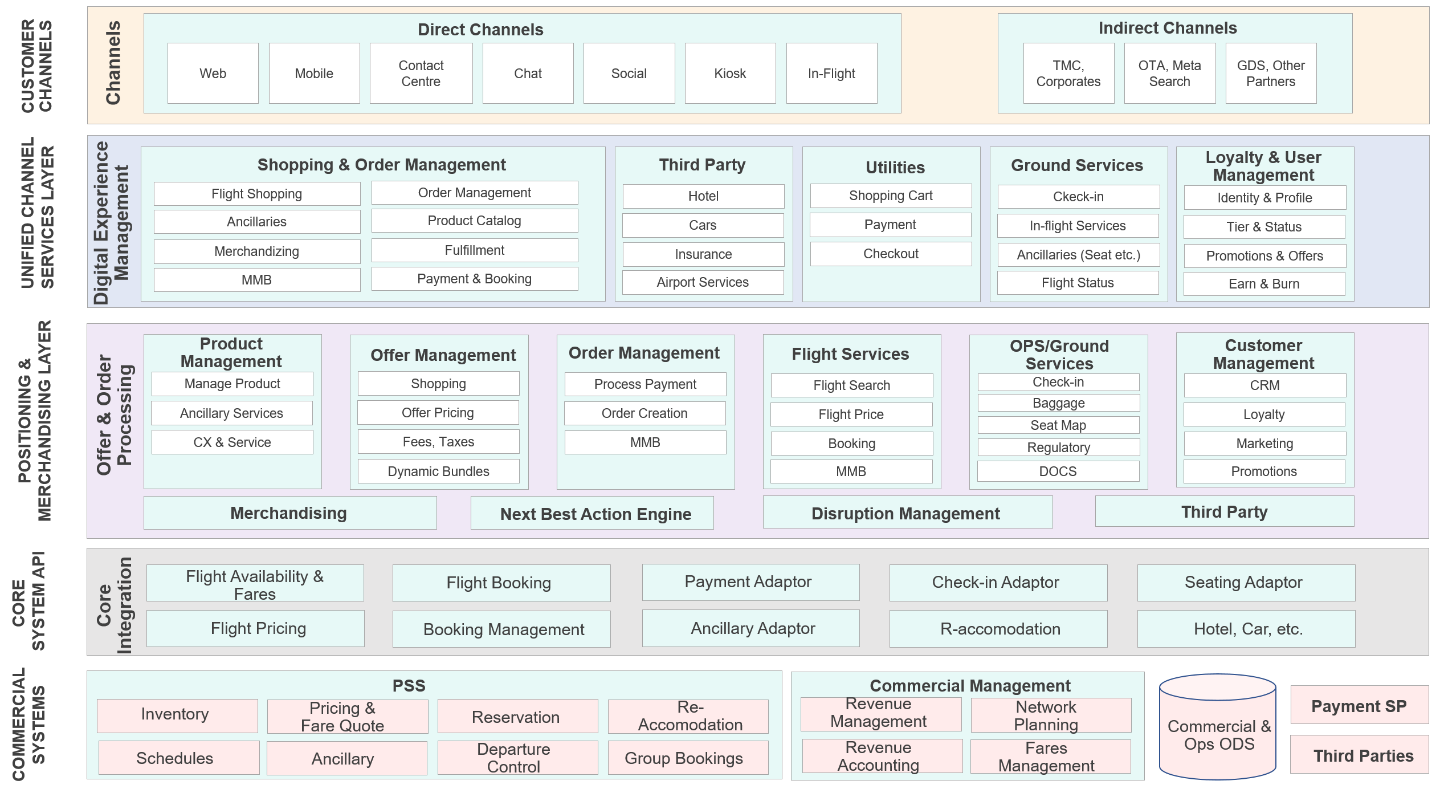
The commercial systems layer includes airline core systems that allow smooth operations across reservations to passenger travel. The passenger management block comprises Passenger Service Systems (PSS).
Commercial management includes planning and operational systems for revenue accounting, revenue management, network planning (fleet planning, network management, network data analysis, alliances, and codeshare), and fares management.
Other airline systems for loyalty, CRM, partner systems also are integral to Commercial Systems. Commercial and Enterprise data sources can power analytics for personalization, contextual interaction, and monetization.
The core system API layer provides access to the core capabilities provided by commercial systems. These may include PSS system APIs like availability and fares, pricing, reservations, schedules API as well as standardized APIs for Payment Service Providers and disruption management. This core integration layer encapsulates the core commercial systems and uses common standards and integration patterns to integrate with PSS and other backend systems.
The Propositioning and Merchandizing layer is responsible for the Product definition, servicing, and distribution functions. This includes the capability to bundle and merchandise with ease, and without much change to the core PSS systems. New technologies and nimble solutions enable airline commercial business users to easily configure and manage advanced merchandising strategies, including dynamic product offerings, bundling with real-time interaction management (RTIM) capabilities for contextual and personalized customer interaction. Dynamic offer capabilities coupled with Order Stores outside PSS provide flexibility and dynamism to excel competition and launch newer commercial strategies with ease.
The unified channel services layer is the direct interface with customer channels. Airlines have been striving to build a complete omnichannel experience for their customers, and this layer provides the capability to standardize the customer channels. Additionally, this layer provides alignment to customer analytics and real-time operational data to drive contextual customer communication across channels.
The customer channels layer abstracts business logic from the channels and protects the web, mobile, and other channels from any changes to backend system logic. Airlines have been able to successfully encapsulate their distribution channels from changes to PSS, thereby making this a failsafe option to implement.
The different layers of this architecture are loosely coupled and hence are easy to change. In the domain model depicted above, the user interface, business logic, and data access logic are separate giving rise to improved maintainability, flexibility, and scalability. These benefits show up as higher customer engagement and superior experience facilitated by rich functionalities in the digital space and thus drive revenue growth for airlines. Utilizing the benefits of layered architecture can lead to numerous strategic advantages like separation of back end and front end of applications, better governance and control, and a single source of truth for decision making across the enterprise which in turn leads to future growth.